The Fool
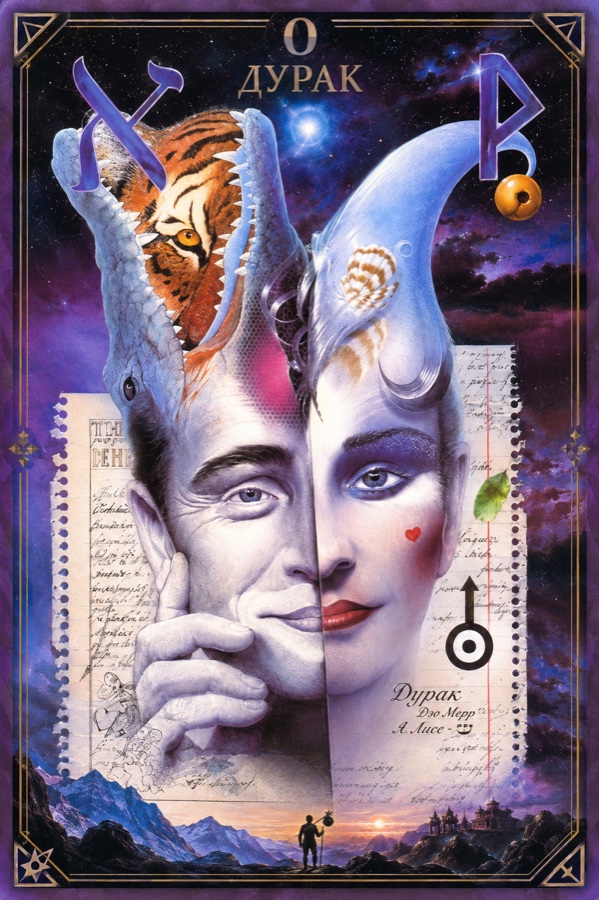
“Röhrig Cards” deck · card #0
 🔍
📌 Save to Pinterest
🔍
📌 Save to Pinterest
"Life is not a problem to be solved, but a reality to be lived."
Buddha
The world, as the ever-repeating circus of life, grants us an understanding of this ring: wild animals and their tamers, spectators and acrobats, clowns and jesters. In this vanity fair there is room for everyone.
With the Fool we reach the end of the Tarot's cycle. The Fool is at once beginning and end. He may be placed either at the close of the twenty-one-card series of the Major Arcana, or as its opening, right before the Magician, the sorcerer. The Fool closes one cycle and opens another. That is why the number that corresponds to him is zero, symbolized by the circle. He serves as the turning point between the lower and higher levels on the spiral of realization.
The number zero also contains all other numbers. Though it has no value in itself, zero accompanies every other number and raises its worth. It is like the Fool, who embodies the knowledge of all the other cards yet is himself utterly without value. He is the sage who is able to become a child again. He is like the innocent, simple Parsifal who, nonetheless — or perhaps precisely because of his simplicity — found the Holy Grail. The Fool is like the Wandering Jew, leading humanity forward from one cycle to the next along the spiral of life. But he is also a child, a sexless being, because he (or rather "it") has not yet separated from the primal unity. Later the child will decide whether to become the Magician or the High Priestess.
Yet the Fool is also the sage who embodies all the experience accumulated by the end of the previous cycle. Over the course of the cycle he has met and overcome all his fears, until nothing remained but himself. Death, the ultimate fear, no longer holds any meaning for him. He sees that his body is nothing more than a garment which, one fine day, he must take off and exchange for another. He knows everything and has understood everything, which is why he is able to laugh; or perhaps he knows nothing and has understood nothing, which is why he is able to laugh.
In many classic Tarot decks the Fool is shown carrying a bundle said to contain the four stages of Indian wisdom (jungle, forest, garden and house) that leads to the highest truth. He has passed through the world's dark jungle, found the first ray of light in the forest, the bright illumination in the garden, and now, at last, can rest at home. One fine day, after one more turn of the Wheel of Fortune and one more plane, he will again find a table set before him. On it he will find the four elements waiting for him, and once more he will dare to enter a new beginning as the Magician.
Placed here at the start of the game, the Fool embodies unconscious consciousness; he has not yet become aware of his own consciousness. He must pass through twenty-one stages of the Tarot, and at the end of his journey he will, at last, attain conscious consciousness. Only then will he be able to understand that the whole world dwells within his own thoughts. His world is identified with his own thoughts, and he comes to understand that everything he sees and hears is nothing other than his own projections. Herein lies the root of the Indian wisdom that teaches that the world in which we live is an illusion (maya). If a person is able to recognize the surrounding world as an illusion (a mirage), he can also transcend that illusion. If, while dreaming, we can realize that we are dreaming, then we stand on the threshold of leaving the dream and on the verge of awakening. The world is a projection, a dream; God is the only reality.
The Tarot of the Aquarian Age depicts the Fool as a two-faced figure. The left side of his face embodies the masculine aspect: smiling, knowing and indifferent, it embodies chaos, where there is room enough for everything within one vast chaotic unity. A crocodile, captured in the act of swallowing a live tiger, forms the cap that crowns the masculine half of the Fool's face. The tiger and the crocodile are sacred animals, but at the same time they symbolize animal tendencies. The other half of the Fool's face shows a beautiful woman, likewise laughing and knowing, who embodies freedom and the principle of order. Her cap is a whimsical weave of exquisite feathers. The Fool is at once she and he, chaos and wisdom, beginning and end.
This card belongs to the first letter of the Hebrew alphabet, ALEPH. ALEPH denotes the head of an ox. Why not the whole ox? Because only the head has been born. The rest of the ox remains in another dimension, in the unmanifest world. The second important feature of ALEPH is that this letter can be seen and read, but it cannot be spoken aloud. ALEPH is the beginning of unity.
The rune WUNJO means bliss, joy and pleasure. It embodies generosity, just as the Fool is the father of merriment.
The astrological sign corresponding to this card is Uranus. Uranus is the planet of intuition, spontaneity, inventiveness and originality. Uranus embodies a new sense which is, to this day, one of the most perfected of senses: intuition. This new sense marks the beginning of a new age. Only with the emergence of this new sense — with the birth of intuition — can the essence of the Age of Aquarius truly be embodied.
About the author · Copyright · Privacy Policy
© 2026 Nikolai Chechelnitskiy (Nikola Blajen). All card artwork and texts are copyrighted.