Death
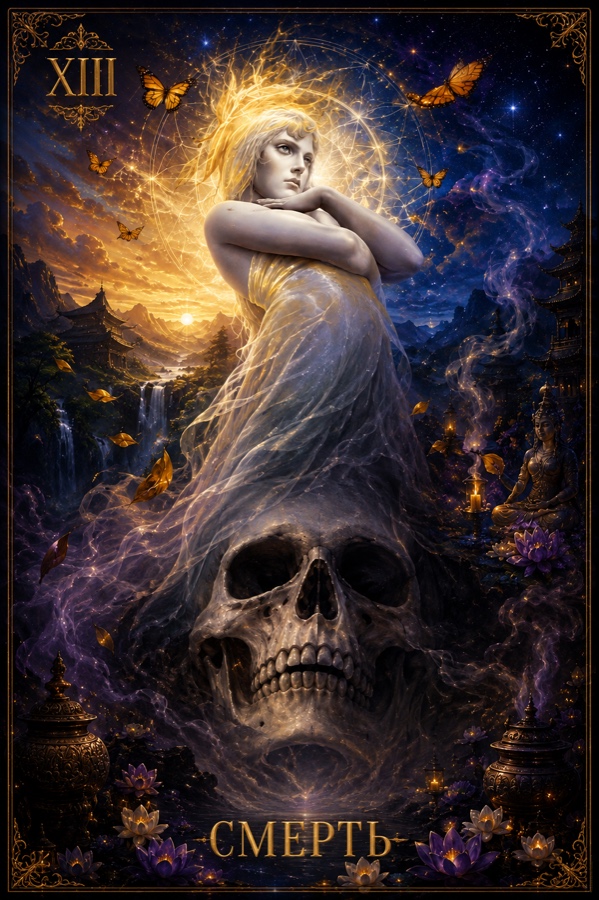
“Röhrig Cards” deck · card #13
 🔍
📌 Save to Pinterest
🔍
📌 Save to Pinterest
"Every time life calls, the heart must be ready to say farewell and begin again."
Hermann Hesse
O Death! You merciful father-god, you who lead people from becoming to becoming, be welcome among us. Without you we would not recognize the precious gift of life, would not be grateful enough to accept it. You begin to accompany us with our very first breath and wait patiently for us to draw our last. Your loving service to humanity is in no way cruel; only those who do not know you, or those who cannot remember their previous encounters with you, are troubled, out of ignorance. This fear is the only true Death.
If a woman and a man cannot become mature enough to one day overcome their fear of Death, they will fall into the hands of that beautiful friend, great Change.
In many cultures death appears in the image of a woman. In all the Romance languages, for instance, the word denoting death requires a feminine article — la morte, la muerte, or la mort — and each of these words uses the same basic letters present in the word "mama" in those same languages. After all this, would you not wish for your own body to one day be lowered into the comforting, soft soil of Mother Earth?
Matter turns into mother and transcends her, while the mother herself is a materialized part of God. Through the gift of the body which, enriched by life's experience, now returns to her, she herself becomes one with its sensations. Only in this way can she transform into the father, into the union that reigns eternally.
The death of the physical body frees the spirit, which is now free to return to the source, to undergo the necessary purification and prepare itself for its next incarnation in earthly life. Together with its new birth into the material sphere and its new entry into the world of becoming, the spirit is once again accompanied by its mother (la morte).
The Tarot of the Aquarian Age reveals the aspect of life and death in a remarkable way. In the lower part of the card is depicted a human skull, out of which an angelic female body arises. This figure represents both Death and rebirth: Morte, mother of the new life to come.
The thirteenth card (Death) signifies not only the transformation of our fear of death, but also points to another kind of death in the middle of life, a kind of death that the initiate will inevitably experience one day. The spiritual death of the ego makes the rebirth of the soul possible. People at this stage of evolution feel an initial death, which may be accompanied by the fear of loss and pain, and even a genuine danger to their continued physical existence. In any case, they must spend some time face to face with a higher existence; after undergoing this trial, they return to their "normal" lives stronger, more experienced and enriched. Many initiatory death rituals serve this same purpose. They are meant to free people from the fear of death, thereby making them ready for life. Goethe, too, recognized this when he wrote: "Until you have known this dying and becoming, you are but a gloomy guest on the dark earth." It is important to say "Yes" to Death as the great Changer and Transformer. When you say "Yes" to death, it means you are saying "Yes" to life.
The water sign Scorpio is the astrological sign of this card. In astrology, the scorpion is a creature that carries within it the mystery of transformation and death. The Hebrew letter of the card is NUN (fish). NUN embodies the emergence of life, including human life, from the water at the beginning of time and space in this world.
The rune of the thirteenth card is BERKANO, meaning "birch." BERKANO embodies the birch deity, the primordial mother who watches over the process of human and earthly metamorphosis, who guards birth, death and life, until the new resurrection and rebirth arrives. Death is no longer separate from life, just as life is no longer separate from death. All is one continuum; everything is a continuation of everything else. Krishnamurti clearly expresses the consequence of ignoring this connection when he says: "We have separated life from death, and the gap between the two is fear." We fear the changes that may come if we truly become ready to accept death.
About the author · Copyright · Privacy Policy
© 2026 Nikolai Chechelnitskiy (Nikola Blajen). All card artwork and texts are copyrighted.