The Devil
“Röhrig Cards” deck · card #15
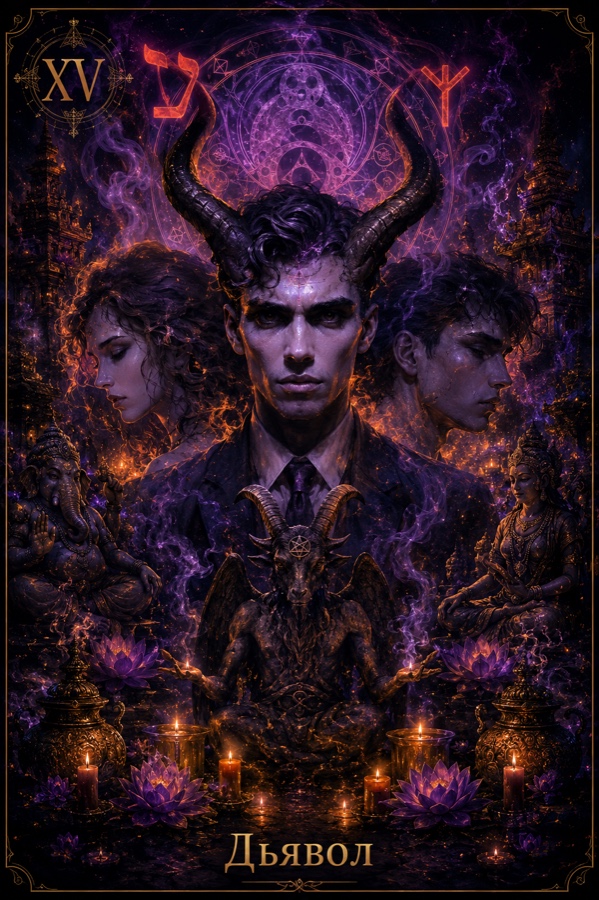 🔍
📌 Save to Pinterest
🔍
📌 Save to Pinterest
"The noble man loves virtue, the common man loves material gain. The noble man weighs the consequences of his actions, the common man thinks only of the profit he can gain from his deeds."
Confucius
After Temperance comes the Devil. This poor Devil once again plays the role of the Tempter. Now that the seeker has begun to feel the safety and balance he has achieved, he is confronted by the great Tempter, temptation in forms corresponding to the seeker's own abilities and inclinations. The Devil can wear a thousand faces. He can appear in the guise of an advantageous business deal, whose profit is achieved at another's expense. He can manifest himself as envy, laziness, greed, gluttony, vanity, pride, and finally as sexuality.
But why was the Devil chosen to play the role of the Tempter? The explanation is simple enough. He feeds on the shadow, the dark side of our being. He holds up a mirror before us, so that we may look into the most remote corners of our ego and understand who and how we truly are. The more we try to suppress or deny our negative qualities, the more they show themselves, and the harder they become to transform. The Devil, with all his temptations and traps, helps us become aware of our own negative manifestations.
For centuries, the concept of the "Devil" was strongly influenced by the figure of Pan, the Arcadian god of shepherds. Part man, part animal, with the horns and hooves of a goat, Pan plays his pipes and drives the nymphs into a state of terrible panic. (The word "panic" derives from Pan.) Like Pan, the Devil also delights in frightening people. Evidently, so long as the Devil can make a person tremble with fear and worry, that person is sure to forget the fact that she or he is a child of God.
What lies behind the figure of the Devil, or the god Pan? If God is truly all and everything, then there can be no place here for anyone but God. In this light the Devil is a manifestation of one aspect of God: God's opposite. In this role, the Devil is very important in the world of phenomena. While the divine energies help humanity ascend, the diabolical energies pull it back down again. Our task, in this phase of mutually contradicting energies, is to rise above the lower energies and reassess the significance of the Devil for humanity, so that he too may once again become a rightful part of the whole — restored to his true unity, but in a state of full awareness.
The Devil is the card of temptation on every plane, including that expression of sexuality which aims only to satisfy the lower instincts. As long as a person remains the victim of this instinctive compulsion, he remains the victim of the Devil. When a person awakens to higher consciousness, he will continue to enjoy sexuality, but will no longer be dependent on it.
Card number fifteen in the Tarot of the Aquarian Age depicts a young man surveying his surroundings through eyes that radiate an almost magnetic attraction. It is very hard for you to escape this irresistible gaze. He can read the thoughts of the person facing him, turning them to his own advantage, enriching both his own creativity and that of the person before him. He works with transformed energy at this phase of development. The Devil can, therefore, be a constructive and creative energy — if that energy is directed into the right channel.
The mechanical metal objects in the upper part of the card symbolize the potential danger of this diabolical energy. The more we mechanize our world, the further we move from our source, and the greater the danger that we will perish in cataclysms. Nature is patient, always ready to nourish and please humanity, but if people treat her cruelly, she will turn against them. The result will be a catastrophe that could end in the total destruction of the Earth. That is why every individual must work on themselves. Pollution of the outer environment is not only around us — it is within us. A radical change must occur at the very core of each individual, so that the surrounding environment too can be purified.
The astrological sign of this card is dedicated to the cardinal earth sign, Capricorn. The goat is endowed with persistence and endurance; it climbs the highest mountain peaks, almost inaccessible summits that cannot be reached without the greatest discipline. The Devil, too, possesses persistence and endurance, and he uses these qualities to lie in constant wait, ready to seize the chances contained within human weakness.
The Hebrew letter AYIN (eye) is found in the left corner of the card. With any eye you can perceive the same thing, regardless of which eye it is. But what kind of gaze is achieved here — only a superficial glance, or a penetrating one? If SAMEKH the serpent (the Devil) prevails in life, then only the outer eye functions, and a person sees only fragments of the truth. AYIN and ALEPH — the first letters of the Hebrew alphabet (which denote unity) — have more in common than you might suppose at first glance. ALEPH embodies God in His Unity; AYIN is the seeing eye. Could it also be the eye of God, an eye turned inward? When we reflect on this, it helps us grasp more deeply the interconnections that join God and the Devil.
The rune ELHAZ means "elk." This rune is considered one of the most powerful in Germanic symbolism. It also resembles an upraised hand with open fingers, a gesture whose deep meaning includes humanity and protection. ELHAZ symbolizes the vital energies and rebirth embodied in the mystical elk. In addition, ELHAZ signifies the transpersonal factor, one that looks upon interdependencies, protection from unwanted outside influence, the unmasking of illusions, and independence from external suggestion.
The energy directly responsible for leading people astray is the energy of the Devil. It would not be wise to try to destroy this energy. The wise allow this energy to serve them, transforming it in order to achieve noble goals.
About the author · Copyright · Privacy Policy
© 2026 Nikolai Chechelnitskiy (Nikola Blajen). All card artwork and texts are copyrighted.