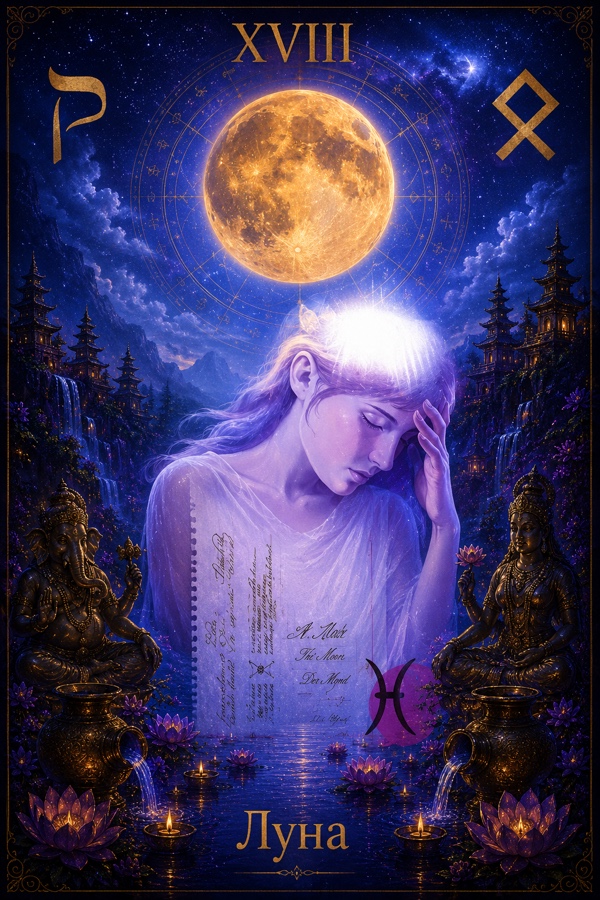
The Moon
“Röhrig Cards” deck · card #18
 🔍
📌 Save to Pinterest
🔍
📌 Save to Pinterest
"In the depth of winter, I understood that an invincible sun dwells within me."
Albert Camus
Everything seems so clear, so obvious, and we feel so close to our goal in card number seventeen. In the card called "The Moon," however, everything once again becomes hazy, unclear, hidden. New obstacles arise to separate the seeker from their goal.
This card in the Tarot of the Aquarian Age depicts a young woman in a dreamy or meditative pose. She holds one hand before her face to shield herself from a beam of moonlight. In truth, though she is neither dreaming nor meditating, she is trying to remember. She examines the past and everything she has lived through. Every action, every thought is assigned its proper place. She does not evaluate or judge things, but simply experiences each thing once more before finally separating herself from it. Every human bond, every relationship she has entered into, dissolves itself in deep love. She knows that every trivial feeling will hinder her progress. She must reject every materialistic desire, she must free herself from every attachment, if she wishes to find and walk the unknown path lit by the moon.
On the left side of the card, a drawing reproduces the Moon as it is depicted in well-known Tarot decks: the face of the moon against the sun. We also see two towers on the horizon, right and left, and two howling dogs before them. At the edge is depicted a pond, on whose surface we see a creature resembling a crayfish. A narrow winding path curves between the pond, the dogs and the towers. The pond symbolizes the human subconscious, all the suppressed deeds and desires that we must now bring into the light, even if that light is nothing more than pale moonlight. The bottom of the pond reaches back toward the origin of humanity, a source that must be found in the past. Just as crayfish prefer to move backward, so too must people travel back through their past all the way to the source. The two dogs are the two human instincts — the instincts of self-preservation and of procreation — the same instincts we already encountered in card number ten (the Wheel of Fortune). We must not allow ourselves to be frightened by these two barking monsters (instincts). If the desire to reach our goal is truly strong enough, we will indeed develop further, and the dogs will not be able to scare us off or dissuade us. The two towers on the horizon symbolize the final material obstacles. They seem threatening only until we have left the misleading moonlight behind, in order to tread the illuminated path.
At this stage of their journey, initiates must once again gather all their courage and knowledge, if they do not wish to be distracted by various outer circumstances. In the Tarot of the Aquarian Age, the moon completely covers the sun. The moon has no light of its own, which means it reflects the sunlight. It appears to shine, but this apparent brightness is illusory, a deception. Although it charms both man and woman, we must learn to see through this charm.
The Moon is the card of dreams that rise out of the sea of the unconscious. As a mystical card, the Moon leads us into another reality. The path leading through the towers parts ways with the earthly dimension and plunges into the sphere of an otherworldly reality.
The Hebrew letter depicted on card number eighteen is QOPH (eye of the needle). It is also the human path leading from the world of commerce, from the here and now, through the gate of the invisible into the world of the future that lies beyond.
The rune of the card is OTHALA, meaning the land of Odal. OTHALA is the sacred boundary. Within it is contained the fundamental plan and the idea of "inner" and "outer." It signifies a place that has been set apart to serve sacred purposes, a temple or a center of worship. OTHALA describes the essence of the tidal mysteries of ebb and flow, which, as is well known, are governed by the Moon.
The Moon is the card of the "wanderer between two worlds." These wanderers are close to overcoming the last fear associated with physical incarnation, so that they may fully immerse themselves in the world of the sun.
About the author · Copyright · Privacy Policy
© 2026 Nikolai Chechelnitskiy (Nikola Blajen). All card artwork and texts are copyrighted.