The Emperor
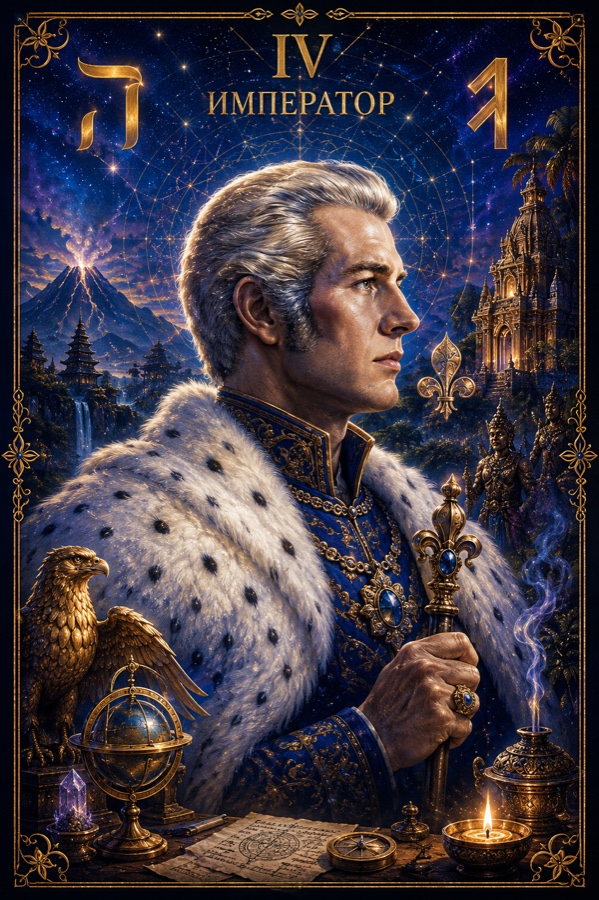
“Röhrig Cards” deck · card #4
 🔍
📌 Save to Pinterest
🔍
📌 Save to Pinterest
"Too many rulers are never a blessing for the people; only one should rule one kingdom alone."
Homer
After the Empress comes the Emperor, who continues her work. If the third card symbolizes creation, the Emperor arrives in order to bring order into that creation. He draws boundaries where they are needed. He shapes and gives form, and rules the material world with wisdom, understanding and love. In the Major Arcana of the Tarot of the Aquarian Age, this fourth card depicts a man in the prime of his life. His face is turned to the east, toward the source of the sun and of the new. He is open to new teachings or new currents, which he can work with and test before passing them on to his people. The hermetic ideogram of the lily (fleur-de-lis) in the right corner is the symbol that best expresses the nobility of his soul. It shows that a true ruler must avoid persecution, primitive imperialism and self-worship, and instead rule with heart, wisdom and reason.
The fourth arcanum is the card of matter. The Emperor knows that his soul is enclosed within matter, and he believes that discipline, order and force of will can set it free. This is an example of how he wishes to accomplish what he has conceived. But since he knows how difficult it is to always make wise and correct decisions, he is also full of love and compassion for others who have not yet reached the same progress as he has.
In the course of his journey along this path to himself, the Emperor has become strict and unyielding, almost harsh. But the inner fire of faith, which inspires him, also allows him to understand that nothing is fixed, that everything is "becoming" in an endless process of transformation. Even his temporary status as Emperor will change, when in the next phase of the process he too must become wiser and more mature.
When you met him earlier, at the stage of the Magician, he was still inexperienced, curious and full of eagerness to accomplish great deeds. Now we meet him again in the phase of the Emperor, where he has become a mature, enlightened and knowledgeable ruler. People who have reached this stage have gained mastery over their bodies. They seek an awakened love within themselves, so as to freely give this love to themselves and to those around them. They respect and establish boundaries; they protect and are protected from above. They give birth to new ideas and thoughts and give them form (matter). Intuitively sensing the power that flows from their thoughts, they have begun to discipline their minds, though they do not yet know the secret of "right thinking" — they will attain that knowledge later.
The fourth card stands under the sign of Aries, which signifies fire, persistence and courage. The astrological ram is ruled by Mars, the god of war. A good Emperor must understand this force in order to transform it from a destructive power into a creative, stable energy.
The Hebrew letter HE (window) adorns the fourth card. A house has a door and a window, through which the Emperor can engage with the outer world, with other points of view and other ideas. The Emperor need only close the door and window again to restore the separation, isolation and solitude that he sometimes needs. When he has once more replenished his inner energy, he can throw the window open again.
The rune ANSUZ symbolizes the royal stag and Izir, a young god of Norse mythology; ANSUZ also embodies skillfulness and skillful speech, the eloquence with which the emperor speaks to his people.
The Emperor represents the highest achievement on the plane of power and ego. This understanding comes to all who have reached this stage, along with the authority and maturity required for their next step on the path.
About the author · Copyright · Privacy Policy
© 2026 Nikolai Chechelnitskiy (Nikola Blajen). All card artwork and texts are copyrighted.