The Lovers
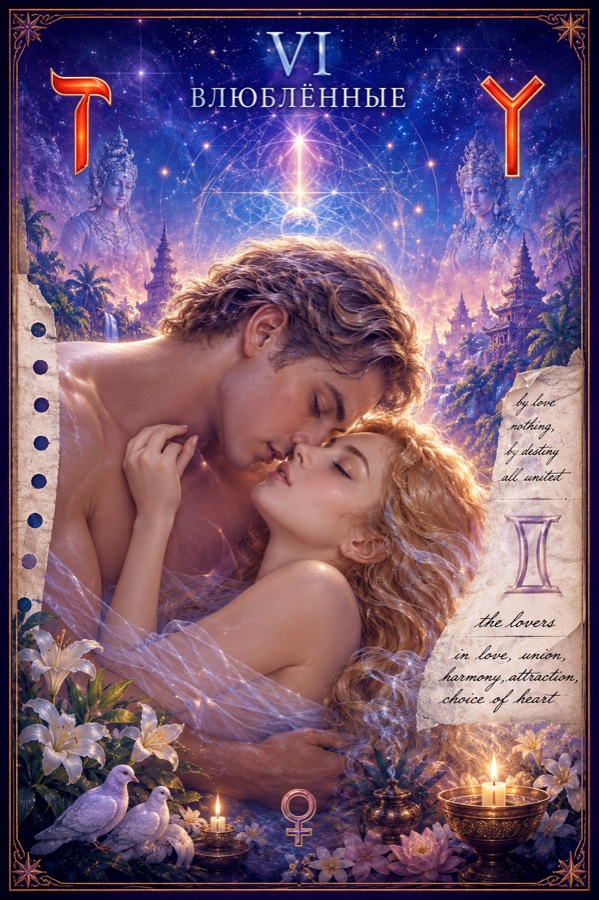
“Röhrig Cards” deck · card #6
 🔍
📌 Save to Pinterest
🔍
📌 Save to Pinterest
"You want to be loved because you do not love yourself, but as you begin to love yourself, you stop asking whether someone else loves you or not."
Krishnamurti
The first five arcana of the Tarot represent five philosophical principles that guide us along the spiritual path. The sixth card gives us the opportunity to practice what they have taught.
Is there anything in the whole world more majestic and more beautiful than to love and to be loved? Through love the individual moves from I to Thou and into the union of We. Love means to open oneself, to give oneself, to fuse together into unity, to dissolve into the other and thus find salvation together. In many rites existing in archaic traditions, sexuality was elevated to the level of a high art and regarded as the key to higher consciousness. It still offers the only opportunity for ordinary beings to act in the image and likeness of their creator, since in the act of creation we ourselves become creators of new life. That is why the bodily act of love has parallels with another act on a higher plane.
The energy that flows from I to Thou overshadows the ego, which fades against the backdrop of this energy. Although the ego still exists, it has yielded the central position, placing Thou at the center.
The sixth card in the Tarot of the Aquarian Age depicts two young people embracing one another. Estranged from themselves, each is in intimate closeness with the other, sharing the lightness of ecstasy. Their faces are peaceful and relaxed, their postures express tenderness and gratitude. Two opposites, united in a single embrace, have found each other. Now they dream the dream of love together.
Adam has found Eve. Their love is not a sin, but it would be a sin for them to be ashamed of their sexuality. Such shame would be like a second expulsion from paradise. A new entry into this paradise lays bare all that is free of false modesty and imposed ethical norms, attains self-realization, and is nourished by a living morality, a source that lies within each of us.
The two figures on the sixth card are naked. Nakedness in the Tarot always means that human beings are showing themselves as they are, with all their desires and aspirations. Having shed the false feeling of shame, they will become as they were in the beginning, before they tasted the fruit of the Tree of Knowledge.
If we look closely at the card, we can make out two separate planes. The lower position holds the faces of the Lovers and belongs to the worldly, to the material world. The upper position encloses the bodies of the Lovers and belongs to the cosmic, spiritual world. People who have reached this stage can decide for themselves which world they wish to belong to.
In many typical Tarot decks this card is called "The Crossroads," because diverging paths are associated with sexuality and decision-making. This defining decision is represented in the image of a young man standing between two women, unable to choose between them. One woman expresses virtue, the other vice. People at this stage of development often find themselves in a dramatic situation, running into conflicts and dilemmas over a decision still to be made. This may involve a choice between two professions, two paths, two women or two men; in any case we must use everything we have learned so far. The act of deciding does not matter in itself; what matters is that we learn to decide from an ethical and moral standpoint. Nor does the outcome of the decision matter very much, since our decision will correspond to our abilities and to what we have learned. When we consider that the human being has been endowed with the power to exercise free choice, and can therefore reach God, we (like every adult initiate) will undoubtedly apply this power to the greatest possible benefit. And besides, there are no wrong decisions, since any and every decision, in the end, favors the process of a person's maturing. God is beyond time; He awaits us in His eternal love.
The sixth card is endowed with two aspects. It is the card of Thou, of a decision about something that lies outside yourself. It is also the card of the Beloved, of harmony, exchange, feeling, and at the same time the card of the unease that precedes a difficult choice.
The Hebrew letter ZAYIN (weapon) tells us that initiates at this stage of evolution must use all their weapons (everything they have been taught), so as not to lose the awareness of unity they achieved and which they feel within themselves at the stage of the Priest. According to the law of opposites, the gate through which they experience love also opens hatred within them, and they will need their weapons in order to defend themselves against that hatred.
The rune KENAZ (torch) embodies the deep connection between sexuality and creativity. It signifies passion and a thirst for love, but also difficulty, sacrifice, and that which attracts.
The card of the Lovers is associated with Gemini, the pair. Mercury, who rules the Magician, also governs Gemini and thus change, movement and information. The element of the twins is air, the mediator that carries thoughts, sighs and vows of love from one lover to the other. The souls of the twins meet each other within a deep, inexhaustible and unbreakable eternal atmosphere that belongs to the Lovers alone.
The sixth card speaks to us from the cosmic plane. But if we wish to learn the lessons of life, we must also descend to the plane of earth; we must become acquainted with physical love. And we must also learn to decide and to make difficult choices. The Magician, on his evolutionary path, must learn whether to use what he has experienced solely for his own good, or for the good of all humanity. Only by sensing his own self-identification can he develop further, as we see on the next card (the Chariot).
About the author · Copyright · Privacy Policy
© 2026 Nikolai Chechelnitskiy (Nikola Blajen). All card artwork and texts are copyrighted.