The Hermit
“Röhrig Cards” deck · card #9
 🔍
📌 Save to Pinterest
🔍
📌 Save to Pinterest
"When a man has found peace within himself, there is no need to seek it anywhere else."
La Rochefoucauld
As you walk the path of the Tarot, the atmosphere grows ever more rarefied. The road is no longer as straight as it was on the card of the Chariot; there is no place to rest, as there was on the card of the Lovers. The ecstasy contained in the card of Strength has acquired a new face, a new dimension. The self-giving ecstasy of the eighth card has transformed, closed in upon itself and turned inward, shielding itself from the outer world, in order to become a radiant, inner truth.
What are those people seeking who have already succeeded in reaching this stage of development? They are seeking truth. They know the world in which they lived, which offered them countless manifestations of truth. But the truth they seek belongs to them. It is pure, independent of outside influence, and springs like clear water from its own inner source.
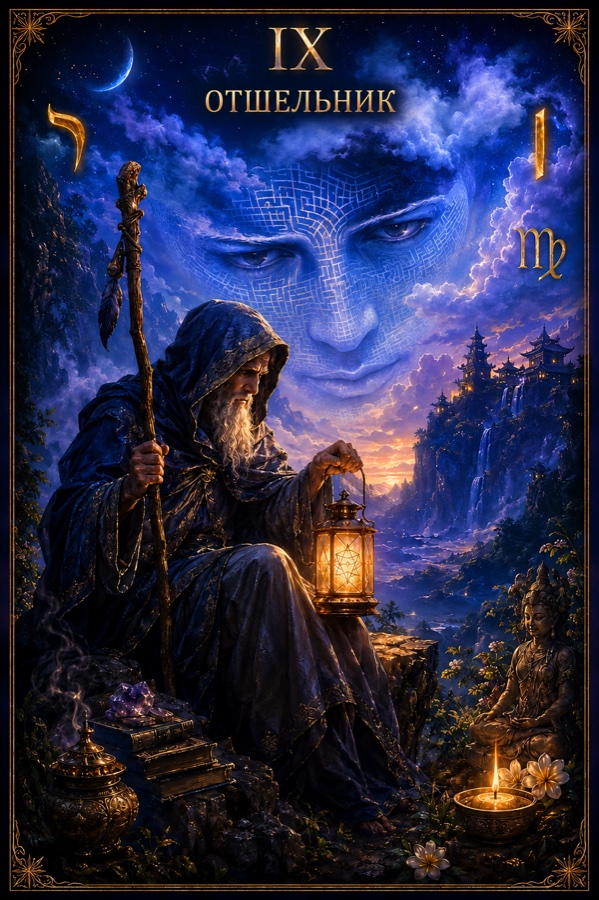
In order to reach this stage of development, seekers must withdraw, isolate themselves from other people and their opinions. The Tarot of the Aquarian Age depicts the Hermit at the center of the ninth card as a man whose penetrating gaze reveals that he has attained self-knowledge and realization. A delicate, net-like pattern adorns his face. The artist could not have found a deeper symbol than this net to express the idea that seekers in the phase of the Hermit have fenced themselves off from everything external. Their net is finally woven and, though it is not visible to everyone, it protects them like a suit of medieval chainmail, guarding their solitude so that they may remain alone with themselves.
Life in the outer world, with its endless pursuit of fame, power and money, has shown the Hermit the meaning of Death for those whose lives are based solely on materialistic values. The Hermit strives for authentic life, for the life that lies beyond death. This, as he now understands, is the only thing that can be found if one follows the spiritual path. That is why he freely joins with all those who, like him, are engaged in fulfilling the "great task." He wishes to continue learning and to affirm himself. He never overestimates his own wisdom, because he is acutely aware that much still awaits him.
He has renounced the importance of his persona, because he no longer wants to act from behind a mask. Persona is the word used to describe the masks that actors in ancient Greece held before their faces, in order to better express the roles they were playing. It was a great step forward when people could allow themselves to step out of the personas in which they so often believed unconditionally. But as long as they continue to find success wearing this persona in the theater of life, separating themselves from their masks will be a difficult task.
The Hermit has freed himself from his mask (his persona). He has isolated himself, distanced himself from society and become a "stranger." Other people no longer understand him, but he does not value their understanding very much. He has experienced the truth within himself, and it speaks the truth to the genuine seeker who penetrates the protective screen and reaches himself.
Alongside the Hermit's central face, the Tarot of the Aquarian Age card depicts him in the form of an old man. Carrying his belongings and a faintly glowing lantern, partly hidden within his long hooded cloak, he is in search of his path. The cloak symbolizes his estrangement from the world. The lantern helps him find his true way. Every step must be carefully examined and tested, but his lantern (which in this case symbolizes his knowledge and intellect) supports him, so that he need not wander lost and without hope.
In many traditional Tarot decks a small snake is shown on the ground at the Hermit's feet. It symbolizes the intuition that, at this very moment, carries with it a wonderful chance, or a misfortune, that allows the Hermit to lead himself out of the labyrinth in which he has temporarily become lost. The net on the man's face in the ninth card of the Tarot of the Aquarian Age can also be interpreted as a labyrinth, a symbol of our entanglement in our own desires and notions. Only Ariadne's thread, the snake (and thus, once again, our intuition), can free us from this self-imposed confinement.
Individuals at this stage of development feel the need to leave everything behind, to become solitary hermits. Often they do indeed isolate themselves in monasteries and ashrams. If, however, they have not yet completed the inner transformation into the Hermit, their problems will inevitably follow them, to whatever corner of the earth they may travel. On the other hand, these individuals may feel themselves to be hermits even while in the thick of worldly life. In the phase of the Hermit, human beings draw strength from their own nature, their inner sources, and know that they can always take refuge in the shelter of their inner home whenever necessary, in order to regain the strength they need for the long path of their solitary wanderings.
The Hebrew letter on the left side of the card is YOD (hand). YOD represents the child who still remained an embryo in TETH. This child has emerged from the mystery and takes fate into its own hands. During the first five years of life, children still enjoy close contact with the other world from which they came; they still know the mystery of their origin. The veil of sleep has not yet closed tightly over their eyes, so they can still joyfully reach out with natural curiosity and take into their own hands the threads that will become the patterns of their own lives.
The Hermit knows neither existential anxiety, nor vanity, nor a thirst for fame or renown. He is simply what he is, by the mere fact that "he is." In this light we can understand why true sages seek the child within themselves. They rediscover the inner child whose existence they had denied for so long, because they were embarrassed that the child would not "fit" their adult world. "Unless you become as little children," or become like the hands of a child, hands that can take hold of everything — and nothing...
The rune ISA in the right corner of the card means ice as primal matter, a source, a primal current, stillness or a period of trial. ISA is the frozen earth from which consciousness arises and carries out its own self-transformation. Sometimes, however, the path is scarcely wider than a hair, and it takes all our skill and dexterity to successfully continue our journey.
About the author · Copyright · Privacy Policy
© 2026 Nikolai Chechelnitskiy (Nikola Blajen). All card artwork and texts are copyrighted.